Conversation Upgrade #4 - UK Fuel Poverty
Another 2 inadequate policy "debates".
Another 2 inadequate policy "debates".
Caveat: everyone, politicians, journalists, public are doing their best, but we're not using the right mediums to make sense of these problems. Either collectively or individually, we can't use the old tools to solve all of the new types of problems we're facing.
As societies get too large to comprehend, that comprehension breakdown is what has always killed them historically.
We can't afford that now with our various civilisation ending technologies like nukes or rapid natural resource depletion.
We need to coordinate at scale. We need new mental tooling that extends to billions at planetary scale over decades.
I believe simulations are our best hope for understanding and navigating complex problems. Their interface can be a serious game or an LLM or a detailed report or a superficial news article, but they all need to be referencing a shared model of reality that we can all buy into or edit, cocreate and improve on.
Wikipedia has shown that millions of people can contribute to make complex topics more accessible.
Can we do the same for constructing a shared model of where we are, where we could go to prosper together, and how we might get there?
We need to upgrade our tools to upgrade our conversations.
I read another news article about the recent increase in cost of fuel heating oil in the UK... which yet again doesn't engage with, or surface the most important facts and figures.
It's more non-news, non-sense-making. This time about the government announcing a "£53m support package". There's so many problems with the article itself, but again I want to be clear: I don't think we can expect one human, even with a team, to get all of this even moderately right. We need to do it collectively.
It's hard work writing these articles, and interviewing people to get their human lived experiences is crucial. But the underlying facts and figures and calculations are just as important too because they allow us to see more clearly what paths are open to our nation and which ones are just wishful thinking.
It's hard producing a policy that's going to be effective... Is it though?
A Few Problems With the Article
Is it a one off "payment"?
One assumes so but it's not stated, why not?
Fundamental Failure for Sense-Making
The only significant lever that I know which can be used is to release emergency stockpiles of oil.¹ Of course this raises questions such as how much to release, how much do we have and how much effect will this have?
Yet under the article's section "What is being done" it claims:
There are emergency stockpiles of oil ... which could be released.
But these are being released - "Countries agree to record release of emergency oil reserves".
So even this basic and important fact is wrong. And there's no easy way to help correct it.
Plans and Criticisms Left Unexplored
Credit for including the following, but frustrating there's no follow up.
It's like someone's never finished their sentence which started "And the most interesting thing is ..."
Shadow energy secretary Claire Coutinho said that while the support was welcome, "the government must go further".
Go further where, do what? Please elaborate.
Liberal Democrat leader Sir Ed Davey called for VAT on heating oil to be suspended and a price cap implemented. Households using heating oil "deserve the same kinds of protections as those on the grid", he added.
What effect would that have? Why have we not done it already? Would this be temporary or long term? If long term how does this fit with your ideals to do xyz policy.
Is this all just noise? Is it just more hot air?
The First Minister of Northern Ireland, Michelle O'Neill, described the £17m pledge as a "slap in the face".
The Sinn Féin vice-president said the funding "doesn't touch the surface of what is required" for those affected.
How much would be enough? And from the linked to article
funding that the UK government had made available to the Executive was "extremely disappointing" and "significantly below par".
I assume that's just more rhetoric rather than comparing the funding to what was done before? You can only be above or below par if you have a par to compare to. So what is the par here? What would be a good amount of funding?
But big props for doing some basic maths!
O'Dowd explained that with half a million homes in NI relying on oil fired central heating the funding works out at around £35 per household.
You don't often see that, and the value's correct, you often don't see that either! Proposed funding per home for Northern Ireland heating fuel, 2026: 32 £ per home.
Frustrating
If you'd not noticed, I think this article is frustrating and mostly pointless.
Reading the comments doesn't make it any better. People are clutching at little fragments of wisdom: it's the oil companies, we need to drill more, drill less, subsidise, regulate, wear jumpers, cold acclimatise. Everyone's got a few pieces of the jigsaw puzzle. We need to weave all of these together into a complete picture.
How Could We Upgrade the Article?
Who qualifies for the support?
The article reports:
Simon Francis, co-ordinator of the End Fuel Poverty Coalition, said it wanted to see details of how the support would work and who would qualify. [...] talk of stronger regulation [...] sounded more like a signal of intent than a concrete plan".
Exactly.
Where's the plan? Who will qualify for funding?
There is no plan at the moment. And this is confusing because for someone with the data already at hand they probably should already have a plan ready to go? And if not then perhaps it would take a day to get a basic plan together and then a week or two asking experts and general public to review and improve it.
Why don't we do this? This seems trivial. What am I missing?
Any plan is not going to please everyone, nor even be a good plan that survives contact with reality but it's better to have a plan and iterate quickly than just waste time talking whilst we're collectively stumbling about confused. And for some people that confusion brings fear and that in itself is needless suffering. Let alone being in a cold home.
How do we define fuel poverty?
We have a definition from the ONS, why not link to it?
Who and how many people are in fuel poverty?
ONS have data on this and provide a "Download this chart as CSV" option. But when they say "Annual Fuel Poverty Statistics (Annex D) from the Department for Energy Security and Net Zero" it would have been helpful if they had linked to that data source.
When I search for that myself I can find multiple pages for fuel poverty by year, but finding the data I need would require me to go through each (large) spreadsheet and manually extract the values from them.
I did some more digging. I just wanted figures for fuel poverty. Specifically older ones from 2014 and earlier. Instead I got https://datacatalogue.ukdataservice.ac.uk/datasets/dataset/cd34d9a5-4369-c560-8d38-5cb0cbffffc6 but it lacks the context for me to make sense of which number is important, and I am now not even sure if it is publicly available despite the previous page suggesting it was.
As WikiSim grows it will be important for the site to surface the high level data sets first and then allow people to dig down for other more granular data sets.
Progress to date
We've got the same graph as on ONS but hopefully it's easier to find as its not buried half way down a page of 8000 words. Nor is it swamped with hundreds of other useful variables but less useful if all you want is this, FYI definition of LILEE is here:
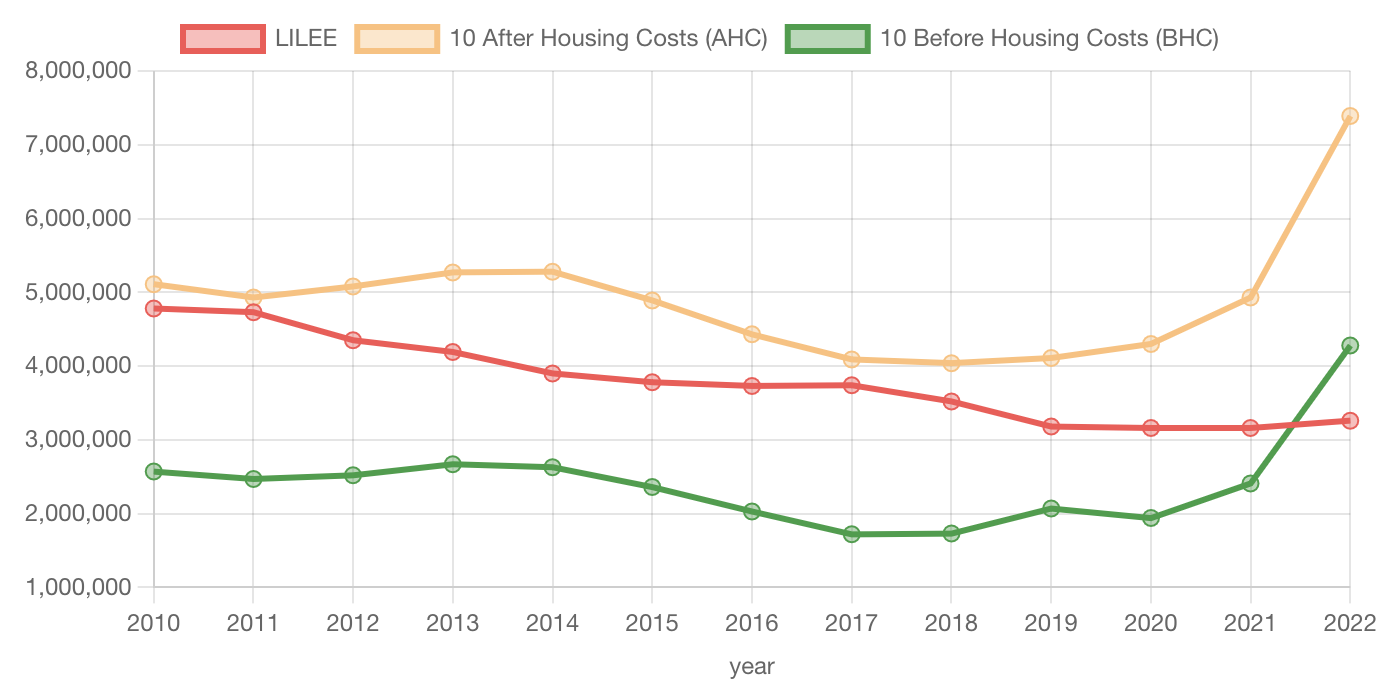
What is the current cost of fuel? Is it really unusual? Kind of not...
As someone who's elderly relative is currently sitting in a cold house from lack of heating oil I'm abundantly aware of how dangerous and even just uncomfortable it is.
But if you look at this graph it's clear we've been here before. I'm old enough to remember 2022... when the nation was plunged into another instance of fuel poverty driven by war... but what did we do to solve it then? Are we doing the same thing now? If not, why not?
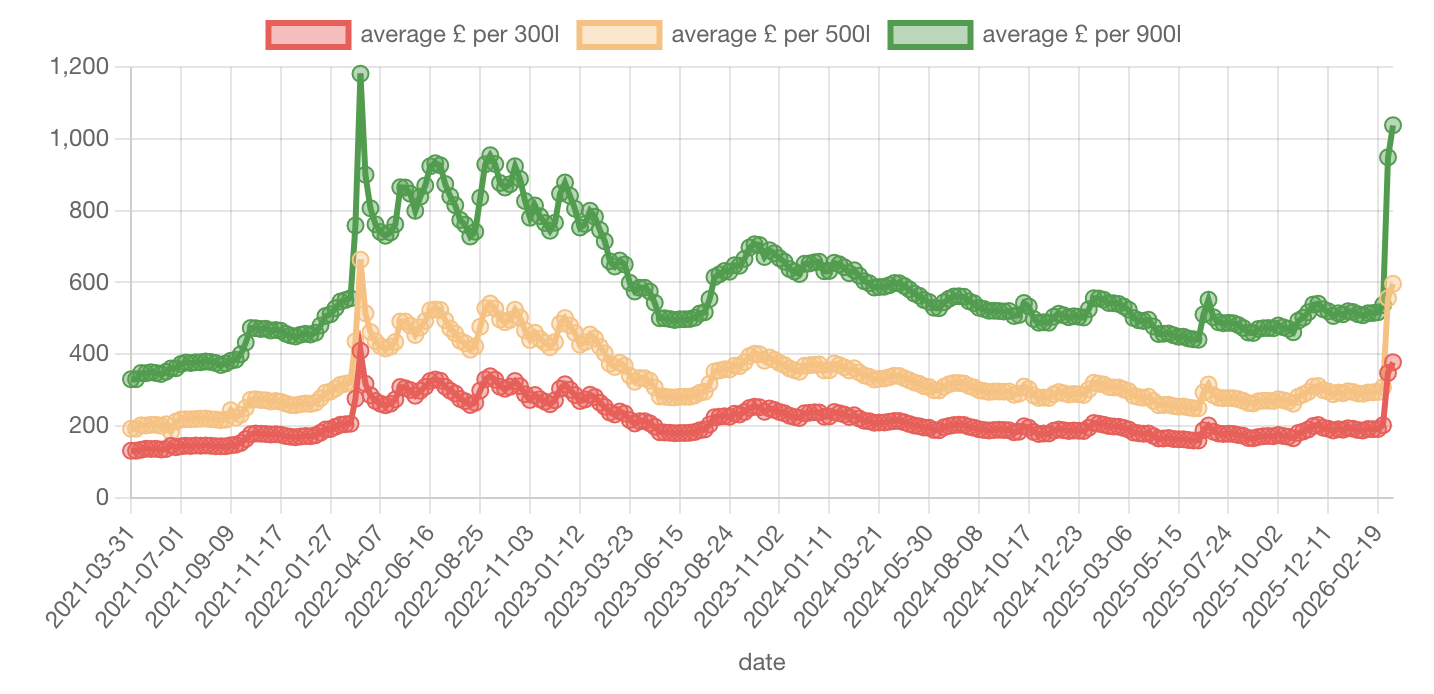
Graphs like these can bring context. Yes it took me a couple of hours making various edits to the supporting CSV parsing functions and adding python scripts² to munge the data but this is now a resource that anyone can use.
Why was this data set as a CSV not easily available on some "dashboard of 1000 important datasets for the UK"? It could have been a Gov ONS, or private company making it publicly accessible, or public wiki.
We've got it now.³ Why didn't we have it before? Or did we and my search engine wasn't finding it, instead just serving me adverts for heating oil from private companies who'd optimised their SEO.
Obviously thanks to consumercouncil.org.uk for providing the underlying data.
Doubly Frustrating
I don't think people realise how disconnected we and our public discourse are from reality and the quite simple data and facts that underlay our collective flourishing or lack of it.
We've just got used to not knowing what's going on, drifting about in hot air, or giving up in apathetic confusion.
It's hard to think about how we think. And we're not understanding where our flourishing actually comes from and then prioritising funding and improving that.⁴
What's The Plan?
In some regards I think we're so close to being able to have 10x news articles, and from those 10x conversations and 10x democratic leadership. We're smart but I think we're just not able to see and imagine how much better our conversations could be.
Why can't we just get all the relevant data about an issue in one place.
Why can't we define all the different actors, actions, and interactions in that same place.
And then why can't we play with the different actions and find actual solutions, that add up.
It can be fun, fast, effective. What am I missing?! Why don't people understand this?
Will it be like a serious game? Where I can play with different actions from gov policies to individual actions and see what might actually work? And then support that politician or take that individual action myself?
Yes that would be the best form of it!
But you said it would be like a data repository used to make it easier for journalists to write their articles. I'm confused.
Well yes it's that too... you need to start getting the data together in one place and as you do then that data will start being useful by itself.
WikiSim seems like a huge idea.
Yes. It is. Maybe I need to stop saying it's super simple, straightforward, and loads of low hanging fruit?
Who's going to collect and clean all this data?
I hope it will be the same people who do it now but if we can provide them with better tools and reason to put it in a public place where others can improve it and where they can then do calculations with that data and other data sets already on WikiSim that might be enough for them?
But who's going to build all these simulations?
Well with LLMs / AI that cost is coming down a bit, and the most important part is that it's opened up the opportunity for others to think of new simulations and experiences for exploring these shared mental models of reality, these digital twins. They can produce visuals and even a broken mock up might be enough to inspire others to build some better sim / serious game.
What's The Plan? ➔ Who Is WikiSim For?
After speaking about this with others the conversation progressed further...
Who is this for in practice, and how much do policymakers or stakeholders really want to engage with data and simulations?
There are three answers⁵ to this:
- Initially it will only be a niche group of data geeks frustrated by modern discourse.
- The back of the envelope calculations produced will act as better training data for LLMs.⁶ LLMs are not yet great at doing these sort of societal calculations,⁷ so whilst the WikiSim content itself might not be used directly by many people, the insights that are formed here will be used by someone when they prompt an LLM.
- Finally if your mental model of a policymaker is someone who wants to be successful and say smart things then those who use these resources will outcompete those who don't.
Okay but on the last point, in many cases, they don't use the tools even when they're available.
Great, so it might be some mix of the following:
Either the tools aren't very good and when we make better tools they'll be used more.
Or the tools are good but we lack the selection pressure for competent and informed leaders.
If it's mostly the later then at least society will be in a position where at least more of us are better informed to know what we should be doing and why.
Notes
² WikiSim helper functions:
- https://wikisim.org/wiki/1183/history
- https://wikisim.org/wiki/1184/history
- https://wikisim.org/wiki/1185/history
Initial data and Python processing script:
³ Improvements can be made to make it even easier to access, and produce different graphs of.
⁴ I'm 2 weeks over my "deadline" to go back to paid work and stop doing this for free. I'm frustrated I haven't found the funding yet to properly support this experiment and help support our societies, democracies, freedom, flourishing, and happiness.
There's so much potential, so much low hanging fruit. I hope it gets picked by someone, anyone, it'll benefit us all when we can have these deeper richer conversations.
⁵ Hypothetical answers as they haven't been proved yet.
⁶ Content from Wikipedia is used in training LLMs both directly and indirectly as it has often historically been copied and repurposed for content on many other sites that are then used to form LLM training data. For example see this paper or this metawiki page that is based on it.
⁸ I'd planned to rant analyse this article about potholes as well but
hopefully you'll understand that:
- I think journalists, political leaders and our citizens are amazing but the world is complex and we all need better mediums/tools to support us to make sense of it.
- There's a heap of basic data, facts, trends, questions, that we need to have easily accessible to us to have better conversations and make better decisions.
- We can collectively find and bring this into one place, and build better sense making mediums, be they serious games or even just having the basic data more easily to hand.
- We can improve our democracy, transparency, we can avoid or reduce the authoritarianism of simple but ineffective answers to complex problems... which ultimately make us all worse off... so that we can all live a little better, more peacefully, more happily.