Simulations for Democracy
Through Participatory and Holistic National Planning
Through Participatory and Holistic National Planning
This project might seem naïve but it's actually already been done very successfully for example in Prof. David MacKay's "Sustainable Energy - without the hot air" which was endorsed by the CEOs of both Greenpeace and Shell. This project is about building on David's work:
- copying that work into a format that can be consumed in minutes rather than days of reading a very complicated book
- making it more interactive and engaging so that most people don't need a PhD to get a rough idea of what plans for national energy add up
- ...it's about getting people into the rough ball park through rough back-of-the-envelope maths. Most people's guesses - myself included - are far away from reality and the constraints imposed by basic physics and maths
- putting all the content in a public space so that anyone can validate and contribute improvements to it
Broken political promises undermine democracy. Promises fail when plans are
made without including the full breadth of a nation's data and expertise - instead
leaving vital information in silos, unseen by decision-makers.
Simulations - serious games - are an underused medium with the power to bridge
those silos. They bring all that information together into experiences that empower
citizens to quickly discover credible plans for the complex problems our societies
face.
A better informed citizenry will support our democracies and politicians in making
and delivering promises that actually add up - restoring trust through transparency,
accountability and logical hope - just when we need it most.
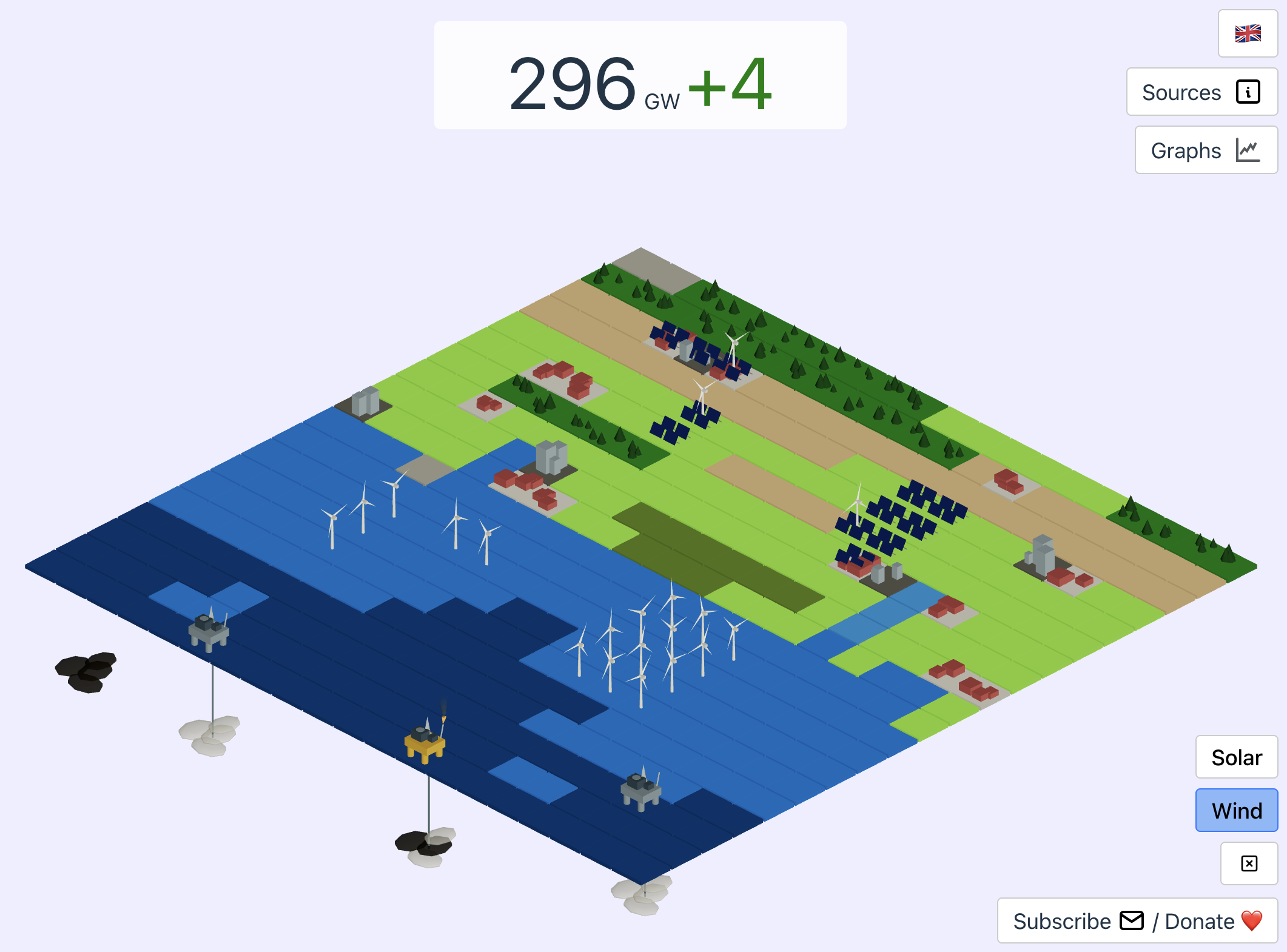
Fig 1. An example of a simulation that helps citizens understand the possibility and
limitations of powering the UK on renewables. This is an abstract map of the UK
based on satelite data processed by UK's Centre for Ecology and Hydrology, ONS,
research from London Imperial, Prof. David MacKay, etc. You
can "play" this very-much-work-in-progress simulation here: wikisim.org/wiki/1272
THE PROBLEM
Our democracy is not working. Politicians regularly fail to deliver on their promises.
Whilst we have an increasing amount of data and expertise about our societies, it's siloed. We're not bridging across those silos. We're not integrating them into whole narratives & political promises which respect the complex reality of our planet, societies, systems, cultures and all their interdependencies, and constraints.
It might seem like we did not have this problem before but we did, and it precipitated the fall of empires and nations into depravation, disintegration and war.¹
Now that we are exceeding planetary boundaries we need to do better, and we can do better.
Another way to view the problem of democratic backsliding and broken political promises is that our current sense making is broken.² We're trying to use tools which are very effective at fixing simpler problems but misunderstanding that they are not useful for more complex problems.
We're trapped in a Einstellung effect i.e. we keep reaching for our familiar sense making mediums of text, images, video, audio and now LLMs. Examples of these include newspapers, TV news, academic papers, government reports, NGO white papers, social media, blogs, podcasts, increasingly chat bots etc.
Our failures to comprehend some societal level problems is a function of the mediums we're using. It's like we keep trying to get into the air by breeding faster horses, or building faster cars.
PROBLEM EXAMPLE: UK ENERGY
In the UK we have a problem with fuel poverty, rising fuel prices, and fuel price volatility. All three are still hotly contested with mutually exclusive claims being repeated throughout the political discourse with no easy recourse to validate or invalidate them.
UK power can be clean...
"by 2030" - UK Gov Jan 2026 (source)
"the mission is a “moonshot”" - Tony Blair Oct 2025 (source)
new oil & gas fields would...
"save the country £13 billion a year" - Reform April 2026 (source)
"lose the country £298 million" - AoT May 2026 (source)
THE REQUIREMENTS
What mediums would do well at the sense making tasks we're failing at?
The medium must
- hold all relevant data and constraints simultaneously
- include alternative view points because all plans are about the future and are thus inherently uncertainty
- be accessible to all citizens
- allow a citizen to interact with it as easily as possible to answer questions, test claims & plans, and validate or invalidate them
- allow everyone to contribute their knowledge to it
- be totally transparent in its current and past forms - same as Wikimedia's version history - to ensure trust
- be sustainable financially, ethically, environmentally
A PROPOSED SOLUTION
A new public space for empowering citizens to discover credible plans for our future which should be composed of 3 layers:
- A public commons of data, functions, and models, about our world, societies, systems, cultures and all their interdependencies, and constraints.
- A public platform for transparent, versioned, open source simulations / serious games that wrap the data, functions, and models. These simulations empower engaged citizens to comprehend radically greater degrees of complexity in significantly less time and discover credible plans for our future.
- Pre-prepared narratives linking to simulation outputs, and visualisations of underlying data. These are also AI ready - easily indexed, linking to full working proofs, operating over cleaned and cited data.
HYPOTHESIS 1
Simulations can connect, contextualise, and compress silos of data and expertise into quick engaging experiences that empower citizens to effortlessly sort wishful political thinking from ambitious plans.
One of the essential capabilities of the human mind is its ability to take in a variety of sensory inputs and construct a mental model, a simulation, of the system being experienced. So when we read one expert's opinion laid out linearly in a few hundred pages of a book, we are building up a rich mental model that we then use to run simulations with.
This is wonderful, but, in the time it takes you to read one book from one expert a simulation could render that same mental model in seconds for you to experience in minutes. Not only that, a simulation can and should contain the superset of disparate expert opinions and data to enable citizens to explore and validate which future plans are credible and actually add up.
Additionally, simulations can include millions of data points, modelling thousands of entities and relationships, spanning decades and centuries, affecting billions of people i.e. far too complex for an average human to compute / simulate accurately in their heads.
If a picture tells a thousand words, a simulation can tell a thousand pictures.
HYPOTHESIS 2
Simulations are not being used because they are difficult to make, and this is due to three reasons:
- the cleaned, contextualised data is not easy to find and use
- designing simulations is hard
- building simulations (even with AI assistance) is hard
Building one meaningful simulation will propel this medium's utility for complex pro-democratic sense-making.
Once simulations are shown to help us make better decisions, this medium will be recognised for its utility. This will make it easier to attract more players, form a community of simulation makers, and raise the awareness of this and other pro-democratic initiatives supplying further funding. In turn this will support a more functional democracy, stopping and reversing democratic backsliding, and ultimately resulting in a stronger, more prosperous country.
AUTHOR
My name is Alexander James Phillips. I have spent the last 20 years returning persistently to the confusion I experience about not knowing which national plans add up, which claims are valid, and why so many political promises fail to be delivered.
I have prototyped - through self-funding and funded research - numerous web based platforms for collective sense making in complex problem domains. Learning new lessons from each one. The latest is an open source platform for data, models (calculations) and simulations call WikiSim.org
WikiSim.org is an early prototype public space for empowering citizens to discover credible plans for our future.
A public space for data, calculations and simulations.
A Wiki for imagining futures that actually add up.
The first simulation I am building - to test the hypotheses listed here - is a simulation of the UK energy system.
REQUEST FOR HELP
I'd love to chat about this idea and get your thoughts on how it might be further developed. You can email me. I'd be grateful for any words of encouragement, constructive criticism, or questions, or if you'd like to be kept informed of developments.
I'd welcome your comments on this doc at tinyurl.com/wikisim (Google docs)
Some other messy notes (click to show)
Follow On Conversations
Thank you for the feedback so far: Kat, KD, Sam, Emma, Sam2, David, Sam3 (lot's of Sams! 🙂🙂🙂), Em.
Empowering citizens to validate complex claims still won't shift the majority?
You think most people care about logic, reasoning, & facts? Are you serious?
Politicians lying and media manipulating people is the biggest problem, surely?
Simulations are not a new idea, what's different about this?
Notes
¹ Examples include:
- Then let them eat cake - not Marie Antoinette.
- We pretend to work, and they pretend to pay us.
² Sense making is a complex process that involves gathering information, processing it, and then making decisions. When our sense making is broken, we make bad decisions, we have misplaced confidence in those decisions, we become paralysed, or we give up and become apathetic.
Examples of this include:
- Our citizens and politcians can not sort ambitious proposals from wishful thinking.
- Experts who seem to be unable to agree with each other, and unable to even agree which question(s) would illuminate which opinion was correct.
- Most claims are unverifiable. Or more accurately, most claims are not easily verifiable by most citizens. This leaves our citizenry more vulnerable to misinformation, disinformation, and manipulation by those who have the resources to create and spread false or misleading information. Generative AI and social media driven by advertisment / attention economy amplifies this problem.
Most people won't play this. Most are influenced by social media, so what's the point?